Content Strategy
Make Your Content Dance to Your Beat
By The Mediashock Team · 29 August 2025
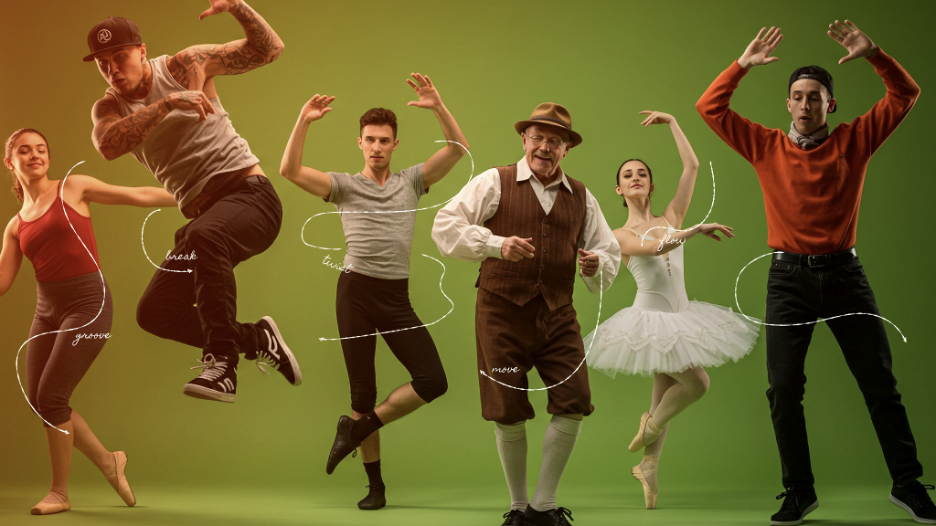
Is your marketing content a harmonious symphony or a cacophony of different instruments?
Ever watched a dance performance that has gone out of sync? The music plays, but each dancer moves to his or her own beat. The performance is confusing and chaotic. Maybe even painful to watch. The worst part is, none of them are actually bad dancers on their own.
Now, think about your marketing content. Is everything moving in harmony? Or does it feel like a group of talented dancers dancing to their own tunes?
Research shows that consistency is key. Brands that deliver a unified message and experience enjoy significantly higher brand awareness, stronger differentiation, and more positive shifts in consumer attitudes. For instance, a study by the Institute of Practitioners in Advertising (IPA) found that the most consistent brands experienced a 27% increase in “Very Large Brand Effects,” including higher brand awareness and differentiation, and a 28% rise in “Very Large Business Effects,” such as sales and profit gains (IPA, n.d.).
In today’s world, where customers expect consistent experiences and messaging from the same brand, stray content becomes a problem.
Content mistakes that are slowing us down
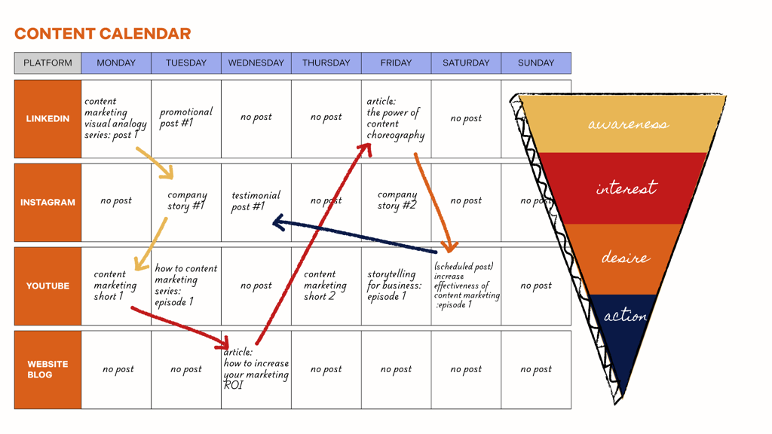
1. We create content without aligning it with the Customer Journey
Often, we don’t stop to ask: Where does this piece fit? What is it helping the audience do — discover, consider or decide?
As creative thinkers, we have bursts of brilliant ideas that inspire us to create content. But good content ideas don’t always mean good results if it doesn’t coincide with what the audience needs to see at that point in time.
Take, for example, a customer who has just learned about a new product. Would you immediately bombard them with a dense technical white paper? They would quickly tune out and lose interest. That’s because they haven’t seen the problems the product is supposed to solve and the context and scenario that makes this product as unique as it is.
It’s like if we walked into an unfamiliar restaurant and were immediately served with a feast table. We are not ready. We need something that’s more aligned with our stage in the journey — which is exploration — something that helps us understand the cuisine style and ease our palates for what’s to come next.
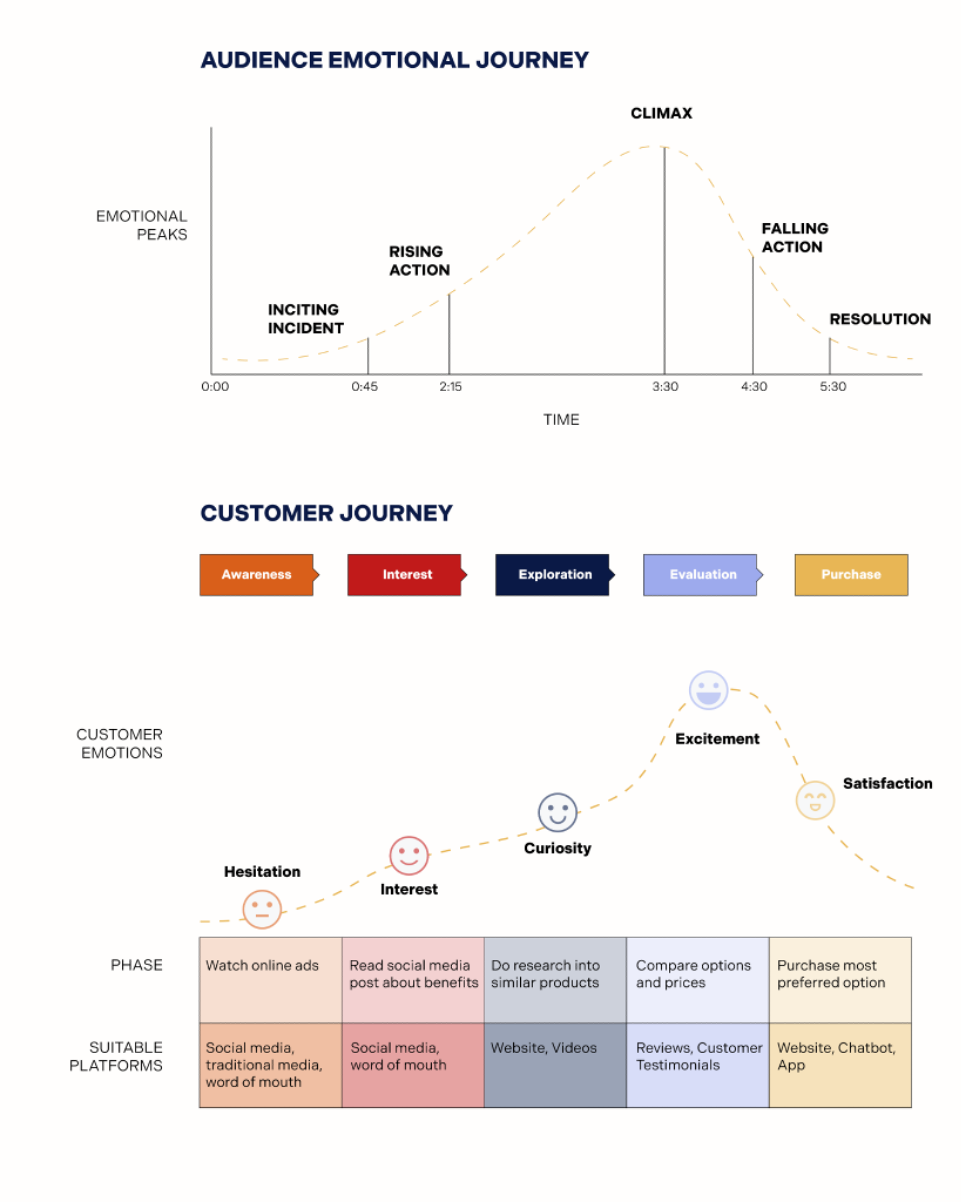
Research suggests that adapting marketing content to the audience’s stage in the journey can increase attachment, engagement, and intimacy to the brand (Wang and Lee, 2020; Hamilton et al., 2021). Familiarizing yourself with models like AIDA (Attention, Interest, Desire, Action) can provide valuable insights into these crucial customer journey stages (Priyanka R., 2013).
Your greatest creative work can actually be ineffective if it’s not strategically placed within the customer journey.
2. We treat each stage of the marketing funnel as isolated projects
Now, let’s say we have the basics of the customer journey down. What connects them? What is the relationship between your different pieces of content? And what is the bigger picture that altogether they are trying to paint?
Like in the earlier example in the restaurant, if your dinner was a five-course meal with five different chefs, each working independently. Without talking to each other, they may end up serving five delicious dishes. But none of them build on each other’s strengths and connect with the larger experience.
Likewise, your guests at your event might love your keynote and product launches, but if post-event, the narrative is not driving forward, the experience doesn’t feel complete. Without a clear story beat for each of these stages, the customer loses sense of the narrative.
Here’s where storytelling comes in. Research has shown that storytelling enhances customer engagement and positively influences purchasing decisions (Rashmi A. and Robert S. W., 1998). By strategically weaving a narrative across and not just within touchpoints, businesses can build stronger emotional connections with their audience, giving them a sense of “the story continues” with each piece of content.
3. We only use channels we’re familiar with
“Don’t fix it if it ain’t broken” might apply to your lawn mower, but when it comes to B2B marketing, we prefer to believe in “improve on it, or someone else will”.
According to a study published in the International Research Journal of Modernization in Engineering, Technology and Science, multi-format, multi-channel content strategies lead to higher conversion rates than single-channel approaches (Chawan & Karcherla, 2025).
And it is easy to understand why. Our brains enjoy novelty. When a person is exposed to novel stimulus, a range of neurological reactions ensues. The end result — heightened perception and motivation, promoting exploratory behavior learning (Bromberg-Martin, Matsumoto, & Hikosaka, 2010). Thus the strongest experience you can craft for your audience is one where they are hit with novelty after novelty, keeping them engaged and having them digging deeper into your content.
The Secret Recipe — Content Choreography
So how can we bring all of this together? How do we ensure that each piece of content not only hits the right note—but also connects smoothly to the next?
Think about doing a play or a performance where you carefully stage every move of every dancer. One where you ensure each talented dancer is doing what they’re best at while still contributing to the overall picture. You masterfully sequence the scenes so that there are highs and lows and each scene sets up for what’s coming next. The overall experience is greater than the sum of its parts.
Imagine you’re about to unveil your groundbreaking innovation at the industry’s leading trade show. Instead of a simple booth sign stating “New Product!”, you orchestrate a captivating sequence:
Phase 1: The Enigmatic Invitation (Teaser). Weeks before the trade show floor even opens, you release a series of visually stunning, short video snippets across your social channels and email list. These aren’t product demos; they’re glimpses into a transformation, ending with a call to action: “Witness the Revelation at [Trade Show Name], Booth [Your Booth Number].”
Phase 2: The Unveiling Narrative (Article / Show Floor Presentation). At the trade show, your booth isn’t just a display; it’s an experience. Instead of just listing features, you tell a story — articulating the frustrations your audience knows all too well, then unveiling your new product as the answer. This narrative is mirrored in a detailed article released simultaneously on your website.
Phase 3: The Voice of Validation (Testimonial / Expert Panel). Throughout the show, you showcase compelling video testimonials from industry influencers or early-access testers. This social proof builds trust and credibility far more effectively than simple product claims.
Phase 4: The Exclusive Opportunity (Early Access Offer). As attendees engage with your product and absorb the validation, you offer an exclusive “Trade Show Pioneer” early-access program — creating a sense of urgency and exclusivity that drives immediate commitments right on the floor.
Phase 5: Sustaining the Momentum (Post-Event Follow-Up). The trade show might be over, but your content choreography continues. Segment your leads by their level of engagement and tailor your follow-up accordingly, converting buzz into loyal customers.
Each piece of content — the cryptic teasers, the unveiling presentation, the authentic testimonials, and the exclusive early access — works in concert to create a memorable and impactful product launch. It’s not just an announcement; it’s an orchestrated event that captivates, educates, and converts.
When All the Elements Align
In a dance, every move has a purpose, from the first step to the final movement. One step leads naturally to the next, creating momentum and telling a cohesive story from start to finish. Marketing can work the same way.
When content is done right, it creates a natural momentum that compels viewers to find out more — because it piques their curiosity the right way. It provides value without being overwhelming and challenges them intellectually without being too difficult to grasp.
A great performance doesn’t just rely on one move. It combines solos, group formations, lighting and music to keep the audience engaged. While a great rhythm makes them comfortable, the occasional novelty keeps them on their toes — the intentional change of tempo makes the experience memorable.
Why Content Choreography is so compelling
In an era where users are bombarded with countless pieces of content daily, a recent McKinsey study highlighted that a staggering 71% of consumers expect personalized interactions. Their likelihood to purchase, recommend, and repurchase hinges on this personalization (Arora et al., 2021).
The growing trend towards content personalization, multi-channel strategies, and interactive formats reflects a fundamental shift in how brands connect with their audiences. According to the Boston Consulting Group, digital transformation has fragmented customer journeys into more intricate, non-linear paths (Yu et al., 2025).
Marketers aiming to thrive in this evolving landscape need robust models to orchestrate the customer experience — and content choreography is one such powerful framework. It’s not just about individual content pieces performing well; it’s about them working in concert. Like teamwork, but for content.
So, before you launch your next campaign, take a step back and ask yourself: Is my audience dancing with me? If not, perhaps it’s time to look into my choreography.
References
- IPA. How creative consistency strengthens brands and business effects (n.d.).
- Chawan, A. P., & Karcherla, H. (2025). The effectiveness of content marketing in building brand awareness and customer engagement. International Research Journal of Modernization in Engineering, Technology and Science, 7(2).
- Bromberg-Martin, E. S., Matsumoto, M., & Hikosaka, O. (2010). Dopamine in motivational control. Neuroscience & Biobehavioral Reviews, 35(3), 457–469.
- Arora, N., et al. (2021). The value of getting personalization right—or wrong—is multiplying. McKinsey & Company.
- Yu, R., et al. (2025). It’s time for marketers to move beyond the linear funnel. Boston Consulting Group.
- Wang, T., & Lee, F. (2020). Examining customer engagement and brand intimacy in social media context. J. Retail. Consum. Serv., 54.
- Hamilton, R., Ferraro, R., Haws, K. L., & Mukhopadhyay, A. (2021). Traveling with Companions: The Social Customer Journey. Journal of Marketing, 85(1), 68–92.
- Rawal, P. (2013). AIDA Marketing Communication Model. IRC’s International Journal of Multidisciplinary Research in Social & Management, 1, 37–44.
- Adaval, R., & Wyer, R. (1998). The Role of Narratives in Consumer Information Processing. Journal of Consumer Psychology, 7(3), 207–245.